Spark · Quiet Mind
Worry Window
Give worries an appointment, so they stop following you around all day.
- 15 minutes a day
- Same time each day
- Not within 2 hours of bed
For you if worries follow you around all day, in meetings, in the shower, at dinner, and pushing them away never works for long.
Instead of fighting worries, you give them an appointment: 15 minutes at the same time and place each day. When a worry shows up at another time, you jot it in a "parking lot" and tell yourself, "Not now. At my window." At your window you go through the list, turn what you can into actions, and let the rest go. Many people find that by the time their window comes, half their worries no longer matter.
What’s inside
- Page 1: four steps and answers to three common problems ("The worry won't wait", "I forgot my window")
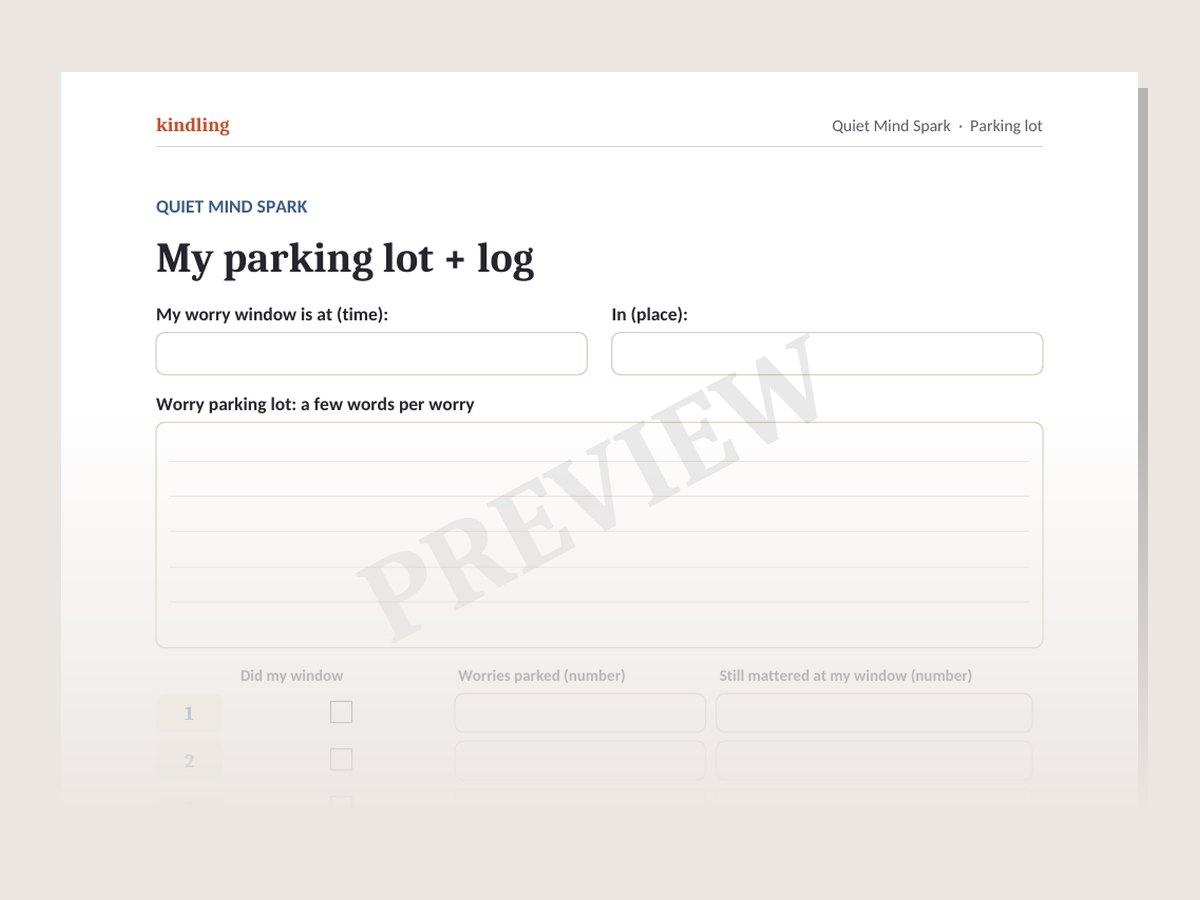
- Page 2: boxes for your window's time and place, and a parking lot for the day's worries
- A 7-day log: did your window happen, how many worries you parked, and how many still mattered
- A Day 7 question that shows you how many of your worries were worth the worry
How to use it
15 minutes a day at a set time, for 7 days. Choose a time at least 2 hours before bed and a place that isn't your bed or desk.
How to do it
- Pick a 15-minute worry window for the same time and place each day. Not your bed or your desk.
- When a worry shows up outside the window, jot it down and say: "Not now. At my window."
- At your window, go through the list. Action? Write it. No action? Cross it out or let it wait.
- When the 15 minutes end, stop. Do something that uses your hands or body.
Why it works
Postponing worry to a set time and place is a long-studied technique called stimulus control. A later trial found worry postponement reduced how much people worried.
The research (2)
- Borkovec, T. D., et al. (1983). Stimulus control applications to the treatment of worry. Behaviour Research and Therapy, 21(3), 247–251.
- McGowan, S. K., & Behar, E. (2013). A preliminary investigation of stimulus control training for worry. Behavior Modification, 37(1), 90–112.
Results are averages from study groups; your experience may differ.
Questions
The worry won't wait.
That's normal for the first few days. Write it down again and bring your attention back to what's in front of you, even for 30 seconds. It gets easier.
License
Personal use. Print as many copies as you like for yourself and your household.
Read more: The worry time technique: give your worries a 15-minute appointment
Next size up
Quiet Mind Kit
A week to turn down the worry. Six tools, one plan. 10 to 15 minutes a day.
See it · $17Reviews
Write a reviewNo reviews yet. We ask every buyer for a review seven days after purchase and show all of them, good or bad.
Goes well with
Quiet Mind Kit
A week to turn down the worry. Six tools, one plan. 10 to 15 minutes a day.
Thought Check
Catch an anxious thought, test it, and find a fairer way to see things.
The Grounding Card
Two minutes to bring your mind back to right here, right now.
Quiet Mind 30
A guided month for everyday worry, building on the Kit week by week.