Kit · Quiet Mind
Quiet Mind Kit
A week to turn down the worry. Six tools, one plan. 10 to 15 minutes a day.
- 7 days
- 10–15 min a day
- Print or type
For you if worry takes up more of your day than you'd like, and you want a structured week to turn the volume down, using methods drawn from CBT.
The Quiet Mind Kit moves through four stages in one week: calming your body, containing worry, testing it, and facing what you've been avoiding. Each day has a short task. By Day 7 you check your worries' predictions against what actually happened, which is often the most convincing part.
What’s inside
- Start here: a 7-day plan with tick boxes and a starting worry rating
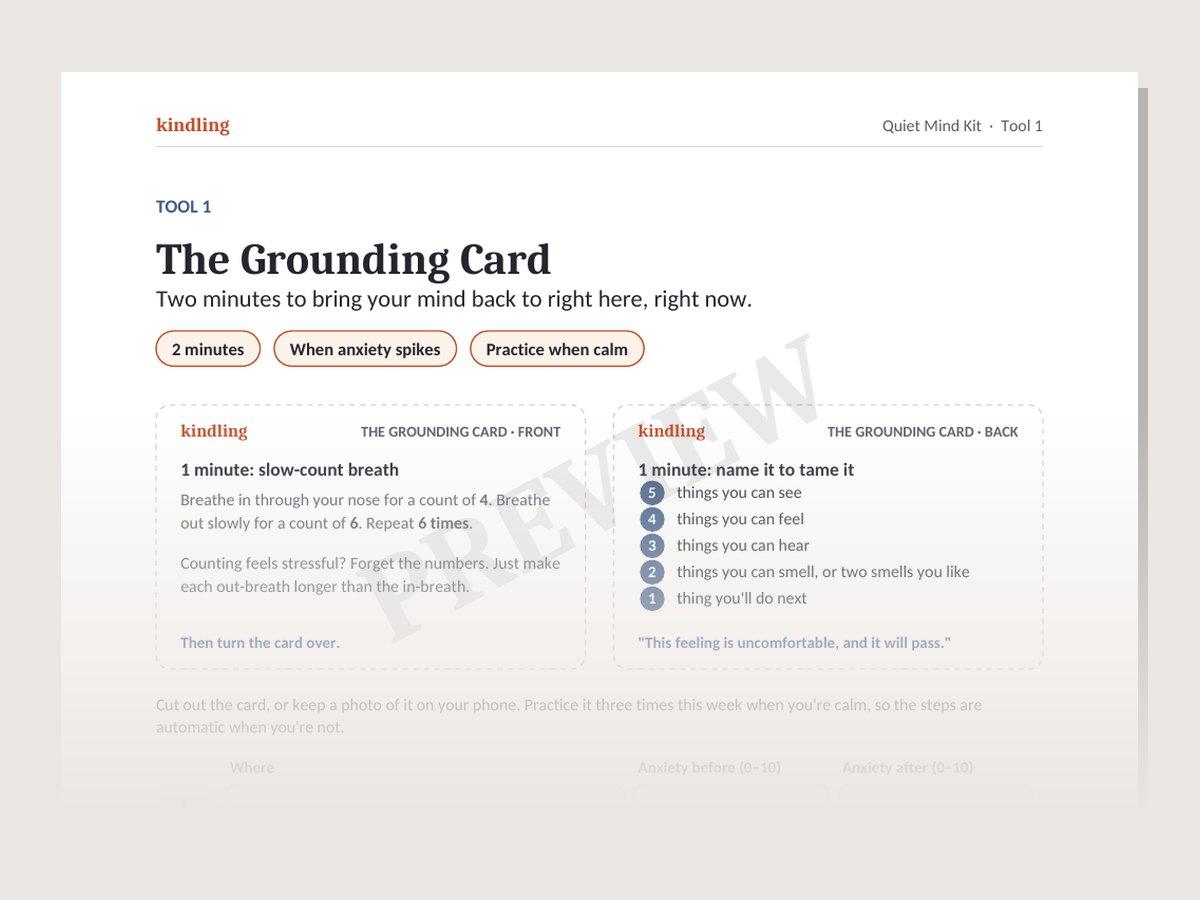
- Tool 1, The Grounding Card: a cut-out card with a 5-use practice log
- Tool 2, Worry Window: steps, a parking lot, and a 7-day log
- Tool 3, Worry Sort: separate real problems from "what ifs", with an action plan for each
- Tool 4, Thought Check: a one-page guide, six thinking traps, and two blank forms
- Tool 5, Prediction Test: write three worries as predictions and check them on Day 7
- Tool 6, Small Brave Step: a 5-rung ladder to face something you've been avoiding
- Day 7 check-in, the research, and when to get more support
How to use it
10 to 15 minutes a day for 7 days.
The six tools
| Tool | What it does | When |
|---|---|---|
| Grounding Card | Two minutes to bring your mind back to right now. | 2 min, any time |
| Worry Window | Give worries an appointment. | 15 min, daily |
| Worry Sort | Real problem, or what-if? They need different handling. | 10 min, Day 2 |
| Thought Check | Catch an anxious thought, test it, find a fairer one. | 10 min, Days 3 and 5 |
| Prediction Test | Write three worries as predictions. On Day 7, check what happened. | 5 min, Day 4 |
| Small Brave Step | Avoiding what scares us keeps the fear big. A five-rung ladder shrinks it. | 10 min, Day 6 |
Why it works
The tools are drawn from CBT for worry: stimulus control, separating current problems from hypothetical ones, evidence-weighing, prediction testing and graded approach. In a study of people with generalized anxiety who logged their worries, 91% didn't come true, and people whose worries were proved wrong more often improved more.
The research (6)
- Zaccaro, A., et al. (2018). How breath-control can change your life: A systematic review on psycho-physiological correlates of slow breathing. Frontiers in Human Neuroscience, 12, 353.
- Borkovec, T. D., et al. (1983). Stimulus control applications to the treatment of worry. Behaviour Research and Therapy, 21(3), 247–251.
- McGowan, S. K., & Behar, E. (2013). A preliminary investigation of stimulus control training for worry. Behavior Modification, 37(1), 90–112.
- Dugas, M. J., & Robichaud, M. (2007). Cognitive-Behavioral Treatment for Generalized Anxiety Disorder: From Science to Practice. Routledge.
- Hofmann, S. G., & Smits, J. A. J. (2008). Cognitive-behavioral therapy for adult anxiety disorders: A meta-analysis of randomized placebo-controlled trials. Journal of Clinical Psychiatry, 69(4), 621–632.
- LaFreniere, L. S., & Newman, M. G. (2020). Exposing worry's deceit: Percentage of untrue worries in generalized anxiety disorder treatment. Behavior Therapy, 51(3), 413–423.
Results are averages from study groups; your experience may differ.
Questions
Is this a treatment for anxiety?
No. It teaches everyday skills drawn from CBT. If worry or panic stops you doing things you need or want to do, or lasts most days for weeks, talk to a doctor or therapist.
License
Personal use. Print as many copies as you like for yourself and your household.
Read more: A week of CBT skills for worry: calm it, contain it, test it, face it
Next size up
Quiet Mind for Practitioners
Structured CBT-style worry homework with a 4-page facilitator insert.
See it · $59Reviews
Write a reviewNo reviews yet. We ask every buyer for a review seven days after purchase and show all of them, good or bad.
Goes well with
Quiet Mind for Practitioners
Structured CBT-style worry homework with a 4-page facilitator insert.
Worry Window
Give worries an appointment, so they stop following you around all day.
Thought Check
Catch an anxious thought, test it, and find a fairer way to see things.
The Grounding Card
Two minutes to bring your mind back to right here, right now.