Spark · Steady
Worry-Free Evening Wind-Down
Deal with tomorrow's worries early, so bedtime is for sleep.
- 15 minutes
- Early evening + bedtime
- 7 evenings
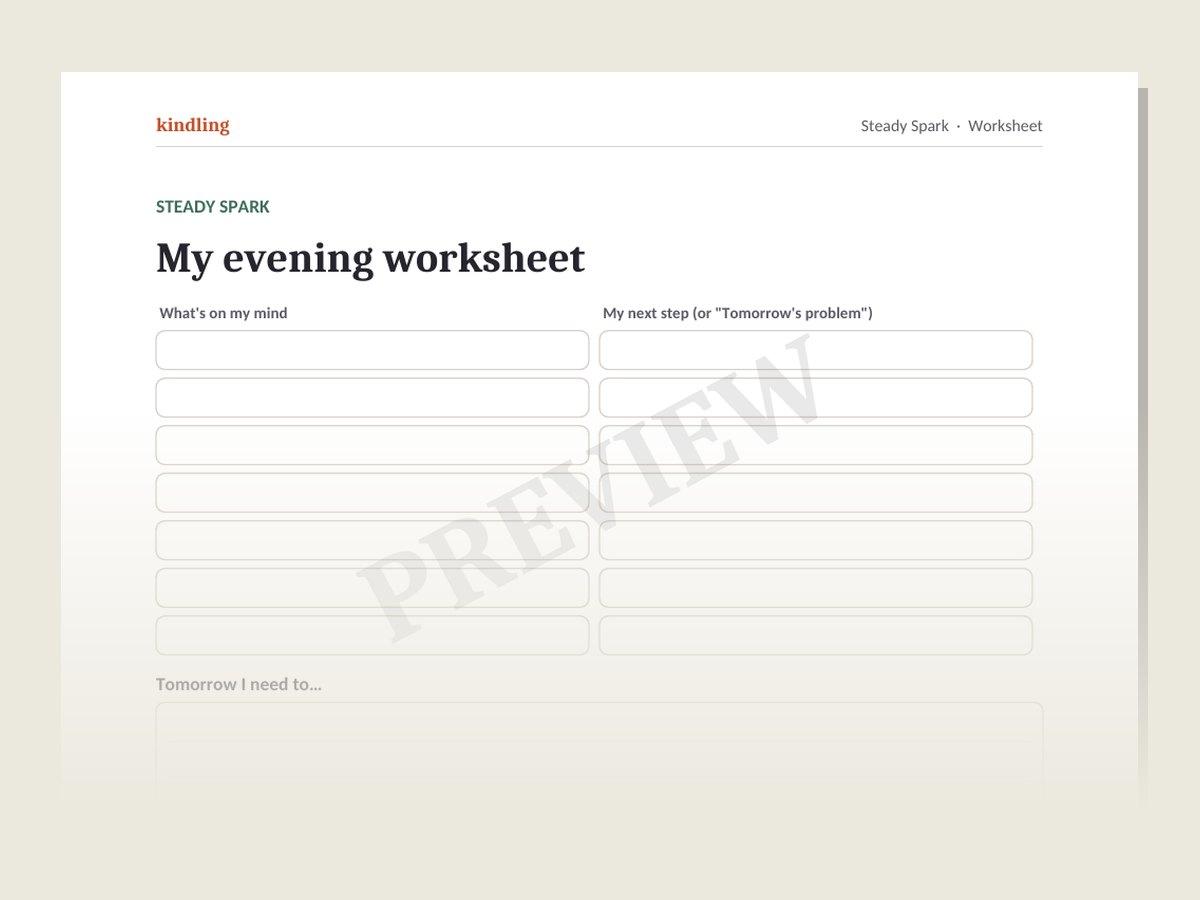
For you if your head hits the pillow and the to-do list starts playing. Tomorrow's meeting, the email you forgot, the bill: it all shows up at bedtime.
The Wind-Down moves your worrying to earlier in the evening, when you can actually do something with it. Part 1, at least two hours before bed, turns what's on your mind into next steps, or labels it "tomorrow's problem". Part 2, in the last half hour, is a short bedtime routine: a specific to-do list for tomorrow and three slow breaths. Bedtime becomes for sleep.
What’s inside
- Page 1: both parts step by step, with examples of what a useful "next step" looks like
- Page 2: a worksheet with two columns, "What's on my mind" and "My next step", plus a "Tomorrow I need to…" box
- A 7-evening tracker: did Part 1, did Part 2, and how easily you fell asleep (1 to 5)
- A tip for shift workers and night owls
How to use it
10 minutes in the early evening and 5 minutes before bed, for 7 evenings.
How to do it
- Early evening: list what's on your mind that might keep you up.
- Write the next step for each one, however small. No step possible tonight? Write "Tomorrow's problem".
- Fold the page in half and put it out of sight.
- Last half hour before bed: write tomorrow's to-do list, as specific as you can, then three slow breaths and lights out.
Why it works
Students with sleep problems who did a similar early-evening worry worksheet had less racing thought at bedtime. In a sleep-lab study, people who wrote a specific to-do list before bed fell asleep faster than people who wrote about tasks they had already finished.
The research (2)
- Carney, C. E., & Waters, W. F. (2006). Effects of a structured problem-solving procedure on pre-sleep cognitive arousal in college students with insomnia. Behavioral Sleep Medicine, 4(1), 13–28.
- Scullin, M. K., et al. (2018). The effects of bedtime writing on difficulty falling asleep. Journal of Experimental Psychology: General, 147(1), 139–146.
Results are averages from study groups; your experience may differ.
Questions
What if I regularly take more than 30 minutes to fall asleep?
If that's been happening for several weeks, a doctor can help; effective treatments for insomnia exist. This tool supports everyday wind-down and isn't a treatment.
License
Personal use. Print as many copies as you like for yourself and your household.
Read more: Can't sleep because you're worrying? Do the worrying earlier.
Next size up
Steady: 7-Day Stress Reset
Six short tools, one plan. About 10 minutes a day.
See it · $17Reviews
Write a reviewNo reviews yet. We ask every buyer for a review seven days after purchase and show all of them, good or bad.
Goes well with
Steady: 7-Day Stress Reset
Six short tools, one plan. About 10 minutes a day.
The 5-Minute Reset
A breathing pattern that tells your body it's safe to slow down.
Energy Audit
Find what drains you and what fills you back up, then change one thing.
Steady 30: A Month to Calmer Days
The 7-day reset, extended into a gentle month with new tools each week and a progress map.