Spark · Bounce
My Coping Menu
A ready-made list of what helps you, for the days you're too stressed to think of one.
- 15 minutes to build
- Use any time
- Fridge or phone
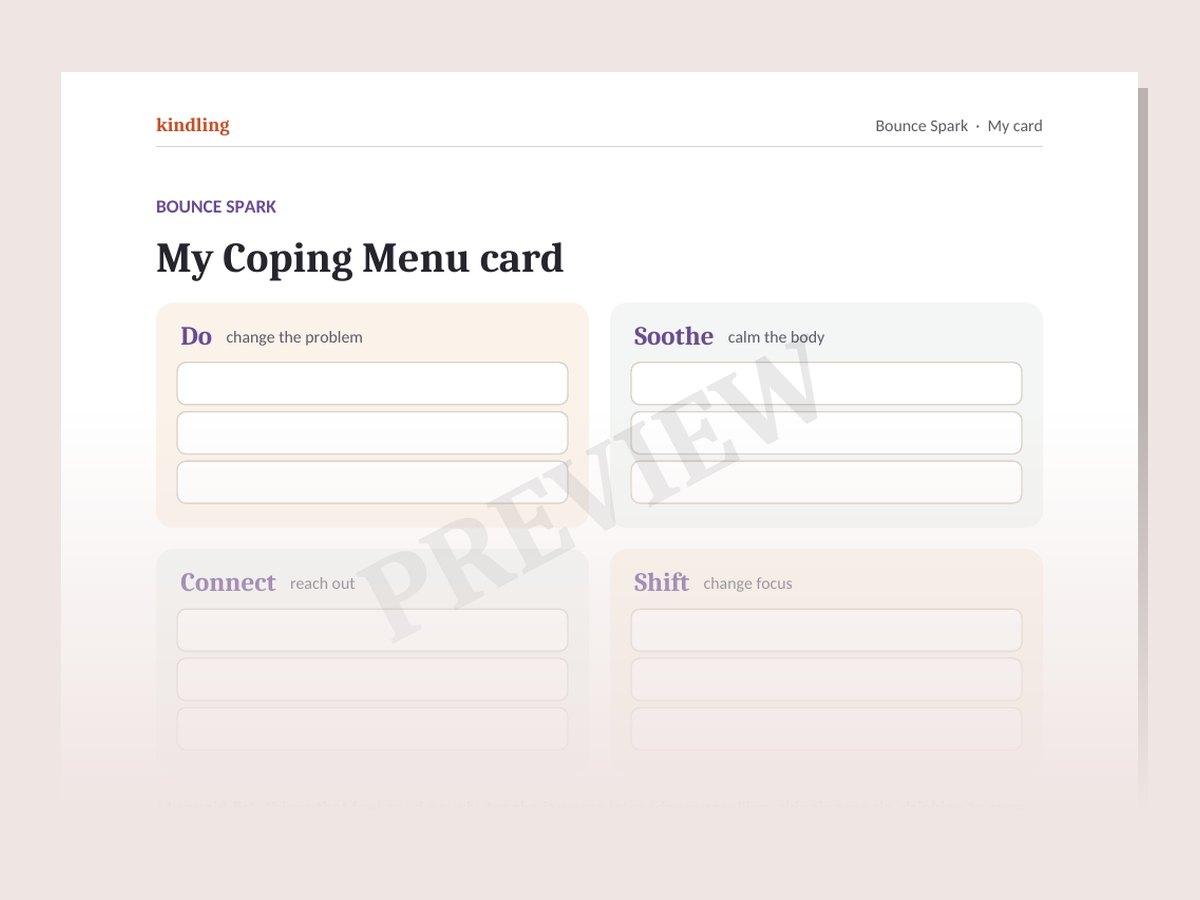
For you if you know what helps when you're calm, but when things go wrong your mind goes blank and you reach for whatever's easiest, like scrolling, skipping meals or cancelling plans.
You build a personal menu of what helps you cope, in four sections: Do (change the problem), Soothe (calm your body), Connect (reach out) and Shift (change your focus). You tick ideas from a ready-made list, add your own, and copy your top three from each section onto a one-page card. You also list the habits that feel good now but make things worse. Next time you're struggling, you just open the menu.
What’s inside
- Page 1: four sections with 20 ideas to tick and space for your own, plus a simple rule for choosing: "Can I change this?"
- Page 2: your Coping Menu card, with three options in each of the four sections
- An avoid-list for what makes things worse, and who you'll contact if it's too much
How to use it
15 minutes to build. Keep the card on the fridge or as a photo on your phone, and use it any time.
How to do it
- Read the four sections and tick what has helped you before, or might.
- Add your own in the blank lines.
- Copy your top 3 from each section onto the menu card.
- Next time you're struggling, ask: "Can I change this?" Yes: start with Do. No: start with Soothe or Connect.
Why it works
Stress researchers describe two broad kinds of coping: changing the problem, and managing your feelings about it. A meta-analysis found that coping flexibility, being able to pick the strategy that fits the situation, is linked to better adjustment.
The research (2)
- Lazarus, R. S., & Folkman, S. (1984). Stress, Appraisal, and Coping. Springer.
- Cheng, C., Lau, H.-P. B., & Chan, M.-P. S. (2014). Coping flexibility and psychological adjustment to stressful life changes: A meta-analytic review. Psychological Bulletin, 140(6), 1582–1607.
Results are averages from study groups; your experience may differ.
License
Personal use. Print as many copies as you like for yourself and your household.
Read more: A coping skills list you build once and keep on the fridge
Reviews
Write a reviewNo reviews yet. We ask every buyer for a review seven days after purchase and show all of them, good or bad.
Goes well with
Bounce Kit
A week of tools for getting back on your feet, at your own pace.
Setback Debrief
Three questions that keep one bad event from becoming a story about your whole life.
My Support Map
See who's in your corner, and what kind of help each person is good for.
Bounce for Practitioners
Coping, support and setback tools for clients after job loss, breakups and failure, with a 4-page facilitator insert.